

How Long Does Probate Take in California? A Step by Step Guide
A typical California probate case takes about 9 to 18 months, although the actual timeline depends on the estate, the assets involved, court scheduling, creditor issues, tax matters, and whether anyone contests the estate. Some cases can take longer, including several years in more complicated or disputed situations.
California probate is a court process used to transfer certain property after someone dies. The process can involve appointing a personal representative, identifying and valuing assets, paying valid debts and expenses, addressing creditor claims, and distributing the remaining property to the people legally entitled to receive it.
Not every California estate needs formal probate. Some property can pass through a trust, beneficiary designation, joint ownership, or a simplified procedure instead.
How Long Does Probate Take in California?
For a straightforward, uncontested formal probate case, 9 to 18 months is a reasonable general timeframe.
That is not a guaranteed deadline for every estate.
California Courts state that the fastest typical probate cases take around 9 months. California Superior Court guidance also states that a formal probate case typically takes 9 to 18 months and can sometimes take longer.
A probate case may take longer when:
- The estate owns real estate that needs to be sold
- The estate has many assets
- Assets are difficult to locate or value
- Creditor issues arise
- There are tax matters to resolve
- Beneficiaries are difficult to locate
- Family members disagree
- Someone contests the will
- Litigation is involved
- The court requires additional hearings or filings
Some California courts specifically note that will contests, complex estates, difficulty locating beneficiaries, and other issues can cause probate to extend beyond the usual timeframe. Some cases may take years.
California Probate Timeline at a Glance
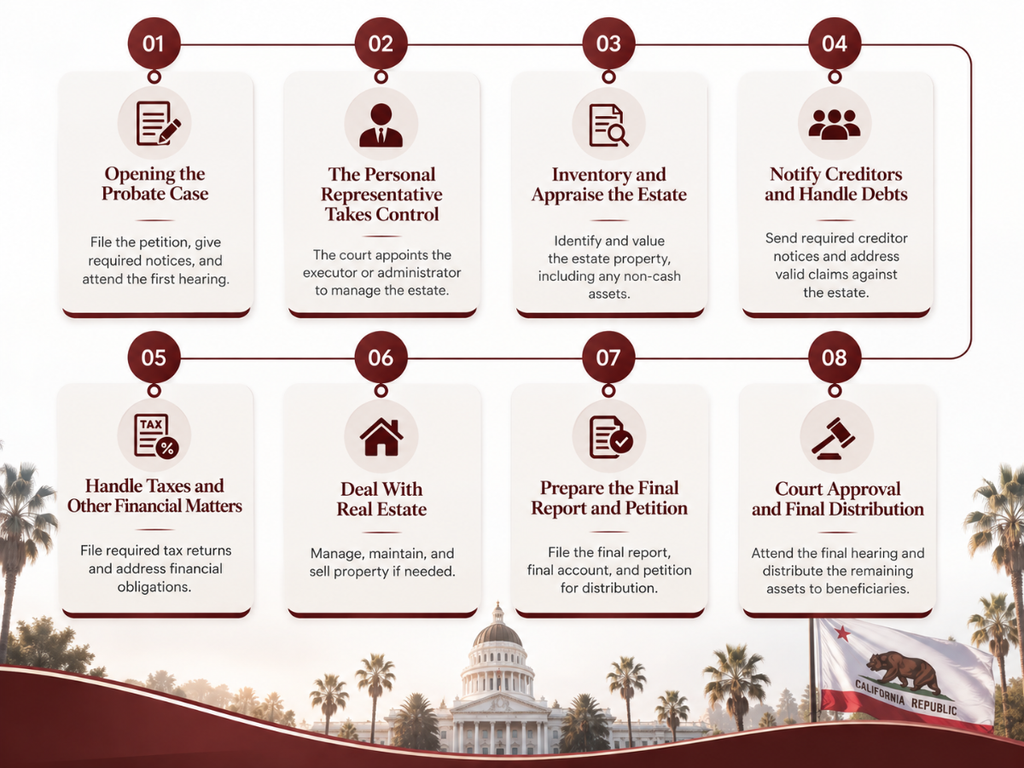
A formal probate case generally moves through three broad stages:
- Opening the probate case
- Administering the estate
- Closing the estate and distributing assets
California Courts use these same broad stages when explaining the formal probate process.
The exact time spent in each stage varies from estate to estate.
Step 1: Opening the Probate Case
The probate process starts when the appropriate person files a Petition for Probate, generally using California Judicial Council Form DE-111.
The petition asks the court to begin the probate process and appoint a personal representative to handle the estate. California Courts explain that the case is generally filed in the county where the deceased person lived. If the person lived outside California but owned property in California, different filing rules may apply.
After the petition is filed, the court sets a hearing.
Required notices must be given to interested people, and notice of the hearing generally must also be published as required.
At the hearing, the judge considers the petition and can appoint the personal representative if the legal requirements are satisfied.
How Long Does the First Probate Hearing Take?
There is no single statewide number of days that applies to every probate hearing.
The timing depends partly on the county court’s schedule and whether the petition and required notices are completed correctly.
A problem with the paperwork, notice, publication, or objections can require additional action before the court can appoint the personal representative.
This is one reason a probate case does not begin with immediate distribution of the estate.
Step 2: The Personal Representative Takes Control
Once appointed, the personal representative becomes responsible for administering the estate.
The person may be called an executor when acting under a will or an administrator when there is no will, although the broader term personal representative is used in California probate materials.
The personal representative may need to:
- Locate estate assets
- Protect estate property
- Identify debts
- Obtain valuations
- Notify creditors
- Handle required tax matters
- Maintain records
- File documents with the court
- Distribute assets after the legal requirements are satisfied
California Courts describe estate administration as the stage in which the personal representative manages the deceased person’s assets and liabilities.
This is where Probate Administration becomes important.
Professional probate administration can help keep the estate organized as the personal representative works through the required legal and administrative steps.
Step 3: Inventory and Appraise the Estate
The personal representative must identify the property that belongs to the estate.
An Inventory and Appraisal, generally using Form DE-160, is used to list and value estate property. California Courts explain that a probate referee is generally involved in valuing non-cash assets.
The amount of time this takes depends on the estate.
A simple estate with a few financial accounts may be easier to value than an estate that contains:
- Multiple homes
- Investment accounts
- Business interests
- Valuable personal property
- Real estate in different locations
- Assets that are difficult to identify
- Property requiring professional valuation
If the personal representative cannot quickly identify or value the assets, the probate timeline can increase.
Step 4: Notify Creditors and Handle Debts
Another important part of probate is dealing with the deceased person’s debts.
The personal representative must provide the required notice to creditors and handle valid claims against the estate according to California law.
California Courts provides a Notice of Administration to Creditors, Form DE-157, which tells creditors that a personal representative has been appointed and provides information about how and when a creditor may make a claim.
Creditors can use a Creditor’s Claim, Form DE-172, to make a claim against the estate.
The creditor process is one reason probate cannot normally be completed immediately after the personal representative is appointed.
How Long Do Creditors Have to File a Claim?
California law provides a significant creditor claim period.
Under California Probate Code Section 9100, a creditor generally has until the later of four months after Letters are first issued to the personal representative or 60 days after the required notice of administration is mailed or personally delivered to the creditor, subject to the statute and its exceptions.
This does not mean every creditor issue will take exactly four months.
It means the estate needs to account for the applicable statutory claim period before it can safely move toward final distribution.
Creditor disputes or questions about whether a claim is valid can extend the process.
Step 5: Handle Taxes and Other Financial Matters
The personal representative may also need to address tax and financial matters before the estate can close.
California Courts explain that a final personal income tax return may need to be prepared for the person who died. If the estate earns income during administration, additional tax filing obligations may apply.
The tax situation varies from estate to estate.
Not every estate has the same tax obligations, so it is important not to assume that every California probate estate requires the same tax filings.
If tax issues, audits, or other financial matters remain unresolved, the estate may need additional time before final distribution.
Step 6: Deal With Real Estate
Real estate can add time to a probate case.
If the estate owns a home or other property, the personal representative may need to:
- Confirm ownership
- Obtain a valuation
- Maintain the property
- Pay necessary expenses
- Address mortgages or liens
- Determine whether the property should be sold
- Complete the required legal steps for a sale
- Distribute the proceeds when appropriate
A property that sells quickly may create fewer delays than a property that remains on the market for an extended period.
Real estate can also become more complicated when beneficiaries disagree about whether the property should be sold or retained.
Step 7: Prepare the Final Report and Petition
Once the estate’s administration is substantially complete, the personal representative can move toward closing the probate case.
California Courts explain that the personal representative files a final report, final account, and petition for final distribution when the estate is ready to be distributed.
A final account may not always be required if the people entitled to distribution provide the required written waiver or acknowledgment under the applicable rules.
The court then sets a hearing.
Notice of the hearing must be provided to the appropriate interested persons.
Step 8: Court Approval and Final Distribution
At the final hearing, the judge reviews the requested distribution.
If the requirements are satisfied, the court can approve the distribution of the remaining estate assets.
The personal representative can then distribute the assets to the appropriate beneficiaries or heirs.
This is the final stage of the formal probate process.
The case is not simply finished because the personal representative has identified the beneficiaries. The required court process must be completed before the estate can be formally closed.
Why Does Probate Take So Long in California?
Several parts of probate require time by law or depend on outside factors.
The main reasons include:
Court Scheduling
Probate involves court hearings and filings.
The timing of those hearings depends on the court and the specific case.
Creditor Claims
The estate must account for applicable creditor claim periods before final distribution.
Asset Valuation
Real estate, businesses, investments, and other non-cash assets may require additional work to identify and value.
Real Estate Sales
Selling property can take months, particularly when market conditions, repairs, financing, title issues, or disputes are involved.
Tax Matters
Tax filings, payments, or audits can delay final administration.
Missing Beneficiaries
If beneficiaries or heirs cannot be located, additional steps may be required.
Disputes
A will contest, creditor dispute, beneficiary disagreement, or other litigation can significantly increase the timeline.
California court guidance confirms that contested wills, complicated estates, and difficulty finding beneficiaries can cause probate to take substantially longer than the typical timeframe.
Can Probate Take More Than 18 Months?
Yes.
The 9 to 18 month range is a typical timeframe, not a guarantee that every estate will be completed within 18 months.
California court guidance explains that the personal representative generally must file a petition for final distribution or a verified report on the estate’s status within one year after Letters are issued, or 18 months if a federal estate tax return is required. If the estate cannot be completed within that period, a status report may be required explaining why more time is needed.
This is important because the one-year or 18-month period should not be confused with a guaranteed maximum duration for every probate case.
Some estates remain open longer when there are unresolved issues.
Can Probate Take Several Years?
Yes.
Some probate cases can take years when significant disputes, litigation, complex assets, tax issues, or other complications remain unresolved.
California court guidance specifically recognizes that some probate cases can take years to resolve.
A straightforward estate and a heavily disputed estate should therefore never be treated as having the same expected timeline.
Does Every Estate Need Probate?
No.
This is an important point.
California Courts state that not every estate needs formal probate. Whether probate is necessary depends on the type of property, how it was owned, and the value of the assets involved.
Property may sometimes transfer without formal probate when it:
- Is held in a living trust
- Has a valid beneficiary designation
- Is jointly owned with applicable survivorship rights
- Qualifies for a simplified California procedure
- Falls under another applicable transfer process
For example, California Courts explain that certain life insurance proceeds, retirement accounts, pensions, annuities, and property held in a living trust may pass to a named beneficiary without formal probate.
Can a Small Estate Avoid Formal Probate?
Potentially, yes.
California has simplified procedures for certain estates that meet specific legal requirements.
The applicable limits depend on the type of property and the date of death.
For people who died on or after April 1, 2025, California Courts currently lists $208,850 as the maximum estate value for the personal property procedure under Probate Code Sections 13100 and 13101.
California also has separate procedures for certain real property.
For deaths on or after April 1, 2025, California Courts lists a $750,000 limit for a specific procedure involving the decedent’s main home in California, subject to the legal requirements of that procedure.
These limits should not be treated as one universal probate threshold.
Different simplified procedures have different requirements, and some assets are excluded when calculating the applicable value.
The limits are scheduled to be adjusted every three years, with the next scheduled update on April 1, 2028, unless the law changes earlier.
How Probate Services Can Help
Probate can involve many separate administrative and legal steps.
Probate Services may assist with matters such as opening the probate case, handling required filings, identifying estate property, addressing creditor issues, managing estate assets, and preparing for final distribution.
The amount of work depends on the estate.
A simple estate may require fewer steps than one involving multiple properties, business interests, significant debts, tax questions, or disputes between beneficiaries.
Professional assistance can help the personal representative understand what needs to be done and keep the administration moving through the required process.
What If the Deceased Person Had a Trust?
If the deceased person had a properly funded revocable living trust, some assets may pass through the trust rather than through formal probate.
California Courts explain that property held in a living trust can pass to the trust beneficiaries without going through probate.
But a trust does not automatically mean that probate is unnecessary for every asset.
A person may have:
- Assets properly held in the trust
- Assets with beneficiary designations
- Jointly owned assets
- Assets that were never transferred to the trust
The assets outside the trust may still require probate or another transfer procedure.
How Trust Administration Fits Into the Process
When a person dies with a revocable living trust, the successor trustee may need to handle the trust assets according to the trust terms.
This process is generally called Trust Administration.
Trust administration can involve:
- Identifying trust assets
- Reviewing the trust document
- Communicating with beneficiaries
- Managing trust property
- Paying appropriate expenses
- Handling required notices
- Distributing trust assets
An estate can require both trust administration and probate.
For example, trust assets may be handled by the successor trustee while an asset that remained outside the trust may require a probate proceeding.
The exact process depends on how the assets were owned and the documents involved.
What Can Cause Probate to Move Faster?
No attorney can guarantee a specific probate timeline.
However, an estate may be easier to administer when:
- The assets are clearly identified
- Ownership records are available
- Beneficiaries are known
- The will is clear
- There are no major disputes
- Property valuations can be completed without difficulty
- Creditor issues are resolved
- Required filings are completed correctly
- Estate assets are easy to manage
California Courts emphasise the importance of organizing information about what the deceased person owned and owed before determining which transfer process applies.
What Can Cause Probates to Take Longer?
Common causes of delay include:
Will contests: A dispute over the validity of a will can add substantial time.
Family disagreements: Conflicts between beneficiaries can make decisions more difficult.
Complex assets: Businesses, multiple properties, investments, or unusual assets can require additional work.
Creditor disputes: Questions about debts or claims can delay distribution.
Tax matters: Tax filings or audits may need to be completed before the estate closes.
Real estate: Property may take time to sell or may require additional legal work.
Missing heirs or beneficiaries: Locating people entitled to receive property can delay distribution.
Court delays: Required hearings and court review can affect the schedule.
California court guidance specifically identifies will contests, estate complexity, and difficulty locating beneficiaries as reasons a probate case can extend beyond the typical timeframe.
When Should You Get Help With Probate?
It may be useful to obtain legal guidance early when an estate includes significant property, multiple beneficiaries, creditor issues, real estate, business interests, or possible disputes.
It can also be important when the family is unsure whether formal probate is required.
California Courts recommend speaking with a lawyer for specific answers because the correct transfer process depends on what the person owned, what they owed, and how their property was structured.
Probate Administration for California Estates
Probate Administration involves handling the estate through the legal process required by California law.
Depending on the estate, this can include opening the case, obtaining authority for the personal representative, identifying and valuing assets, addressing debts and creditor claims, handling required filings, and preparing for final distribution.
The goal is not simply to finish the case quickly.
The estate must be administered correctly and in accordance with the applicable legal requirements.
Final Thoughts
So, how long does probate take in California?
For a typical formal probate case, about 9 to 18 months is a useful general timeframe. But there is no single timeline that applies to every estate. Simple, uncontested estates may move through the process more smoothly, while disputes, real estate, creditor issues, tax matters, missing beneficiaries, and complex assets can make probate take substantially longer.
It is also important to remember that not every California estate needs formal probate. Trusts, beneficiary designations, joint ownership, and simplified procedures can allow certain property to transfer through other methods.
For families handling an estate, Probate Administration and Probate Services can help address the legal and administrative requirements involved in the process. When a deceased person also had a trust, Trust Administration may be required for assets held in that trust.
The right process depends on the actual assets, ownership records, estate documents, family circumstances, and applicable California law.
Frequently Asked Questions
A typical formal probate case takes about 9 to 18 months, although some cases take longer. California Courts state that the fastest typical cases take around 9 months, while California Superior Court guidance describes formal probate as typically taking 9 to 18 months.
A formal probate case generally should not be expected to finish in less than the typical minimum timeframe. California Courts state that the fastest typical formal probate cases take around 9 months. However, some estates may qualify for a simplified procedure and therefore may not need the full formal probate process.
Yes, Complex estates, disputes, tax issues, real estate matters, and other problems can extend probate beyond 18 months. Some California probate cases can take years.
No, Certain assets can transfer outside formal probate, and California has simplified procedures for some estates and property.
A creditor generally has until the later of four months after Letters are first issued or 60 days after the required notice of administration is mailed or personally delivered, subject to California law and its exceptions.
Not necessarily, A will can provide instructions and name an executor, but an estate may still require the probate court process. The overall timeline depends on the estate and whether issues arise during administration.
Property properly held in a living trust can generally pass to the trust beneficiaries without formal probate. However, assets outside the trust may still require probate or another transfer procedure.
Yes, Real estate can add work to probate when it needs to be valued, maintained, transferred, or sold. The time required depends on the property and the circumstances of the estate.
After the court approves final distribution, the remaining estate property can be distributed to the people legally entitled to receive it. The personal representative then completes the remaining steps needed to close the estate.