
Revocable Living Trust vs. Will in California: What Is the Difference?
If you are comparing a revocable living trust vs. a will in California, the main difference is how each document works, when it takes effect, and how your property may be handled after your death.
A will states how you want certain property distributed after you die. A revocable living trust can hold property during your lifetime and provide instructions for managing and distributing that property. When trust assets are properly transferred into the trust, they can generally pass to the named beneficiaries without going through the regular probate process.
A trust does not automatically replace a will in every estate plan. In many cases, a person may use both documents as part of a larger estate plan.
Will vs. Revocable Living Trust in California: The Quick Answer
The important point is that the choice is not always will or trust. A California estate plan may use both.
What Is a Will in California?
A will is a legal document that states what you want to happen to certain property after you die.
It can identify the people or organizations you want to receive your property. It can also name the person you want to serve as executor.
If your estate needs probate, the executor named in the will may be appointed to handle the estate, subject to the court process and California law. California Courts explain that the personal representative is responsible for collecting estate property, paying bills, and distributing the remaining property to people with a legal right to receive it.
A will, however, does not automatically avoid probate.
California Courts specifically note that an estate may need to go through probate even when the person had a will. Whether probate is necessary depends on factors such as the type of property, how it was owned, and whether another transfer method applies.
What Is a Revocable Living Trust?
A revocable living trust is created during your lifetime.
You transfer property to the trust and establish instructions for how that property should be managed and distributed. The person who creates the trust is commonly called the settlor or trustor. The person managing the trust is the trustee.
A revocable trust can generally be changed or revoked by the person who created it, subject to the terms of the trust and applicable law.
One major reason California residents use living trusts is to allow properly funded trust assets to pass to beneficiaries without going through the regular probate process. California Courts state that when assets have been placed into a living trust, those assets can pass to the beneficiaries without going through probate court.
But there is an important qualification:
Creating the trust is not the same as transferring every asset into the trust.
The ownership of the assets matters.
Does a Living Trust Avoid Probate in California?
A properly funded living trust can help avoid probate for assets held in the trust.
For example, if a person transfers an asset into a revocable living trust during their lifetime, that asset may be administered under the terms of the trust after the person’s death rather than through the regular probate process.
However, assets that were never transferred to the trust may still need another method of transfer.
California Courts list property held in a living trust among property that may not need to go through probate. It also identifies other assets that may pass outside probate, including certain jointly owned property and assets with beneficiary designations.
So, a better way to think about a living trust is:
A properly funded trust can help keep trust assets out of probate. It does not automatically keep every asset in an estate out of probate.
Does a Will Avoid Probate in California?
Generally, no.
A will tells the court and the estate representative how the person wanted their property distributed. If the assets are subject to probate, the will may become part of the probate process.
California Courts explain that probate is the legal process used to transfer or inherit certain property after someone dies. It can involve collecting property, paying debts, and distributing the remaining property to people who have a legal right to receive it.
Some assets can pass without probate even when a person has a will.
For example, certain assets may transfer through beneficiary designations or joint ownership arrangements.
This is why estate planning should consider how assets are owned, not only which documents have been signed.
Why Estate Planning Matters
The difference between a will and a living trust becomes much easier to understand when both are viewed as parts of a larger Estate Planning strategy.
Estate planning is not limited to deciding who receives your property after death.
It can also address:
- Who manages your property
- Who handles your affairs if you become unable to do so
- How assets should be transferred
- Who receives specific assets
- What happens to trust property
- How beneficiary designations fit into the plan
- How your estate should be handled after death
The State Bar of California explains that estate planning can involve wills, trusts, asset transfers, probate, trust administration, and other legal matters.
A good estate plan should therefore be based on your actual assets, family situation, and goals.
Will vs. Trust: What Happens After Death?
The biggest practical difference often appears after the person dies.
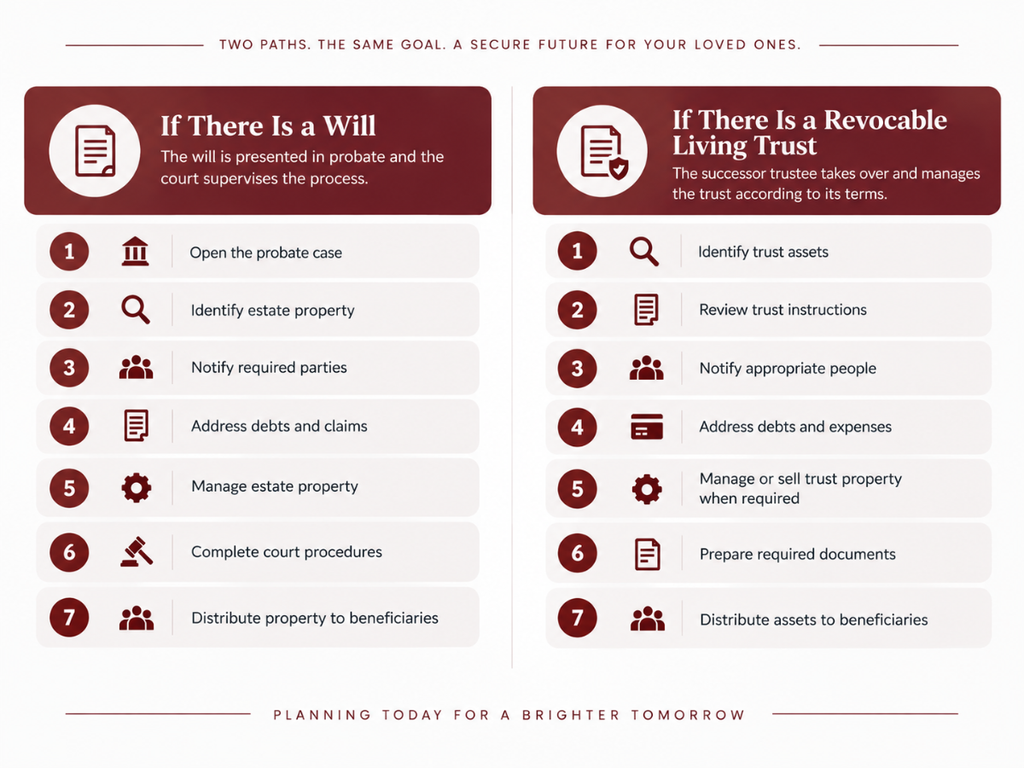
If There Is a Will
If the deceased person’s assets require probate, the will is presented as part of the probate process.
The court may appoint the named executor as the personal representative. That representative then handles the estate according to California law.
The process can include:
- Opening the probate case
- Identifying estate property
- Notifying the required parties
- Addressing debts and claims
- Managing estate property
- Completing required court procedures
- Distributing property to the appropriate people
The exact process depends on the estate and the assets involved.
If There Is a Revocable Living Trust
When the person dies, the successor trustee generally takes over management of the trust according to its terms.
The successor trustee may need to:
- Identify trust assets
- Review the trust instructions
- Notify the appropriate people
- Address debts and expenses
- Manage or sell trust property when required
- Prepare required documents
- Distribute the trust assets to the beneficiaries
This is generally handled through Trust Administration rather than the standard probate process for assets properly held in the trust.
However, if the deceased person also owned assets outside the trust, those assets may require a separate transfer process.
What Is Trust Administration?
Trust administration is the process of handling a trust after the person who created it dies or when administration is otherwise required under the trust.
The successor trustee has responsibilities that can include identifying trust assets, following the trust terms, communicating with beneficiaries, handling expenses and obligations, and distributing property.
The exact duties depend on the trust document and the circumstances.
Trust administration can become more complicated when the trust owns real estate, multiple financial accounts, business interests, or other significant assets.
A person serving as successor trustee should therefore understand the responsibilities involved before distributing trust property.
What Is Probate?
Probate is the court process used to handle certain property after someone dies.
California Courts explains that probate may involve:
- Collecting the deceased person’s property
- Paying debts and bills
- Handling the estate through the court
- Distributing remaining property to heirs or beneficiaries
Not every asset requires probate.
The ownership of the asset is important.
For example, California Courts state that property in a living trust, certain jointly owned property, and certain assets that pass directly to beneficiaries may not need to go through probate.
What Are Probate Services?
When an estate requires probate, the family may need help with the legal and administrative steps involved in the process.
Probate Services can involve assistance with matters such as:
- Starting a probate case
- Identifying estate assets
- Understanding the role of the personal representative
- Addressing creditor issues
- Handling required court filings
- Managing estate property
- Distributing assets after legal requirements are met
The exact work required depends on the estate.
An estate with one simple asset may be very different from an estate involving several properties, financial accounts, business interests, debts, or disagreements among family members.
What Happens If Assets Were Never Transferred to the Trust?
This is one of the most important issues when using a revocable living trust.
Suppose a person creates a trust but leaves an asset titled only in their individual name.
The trust document alone does not necessarily mean that asset is now a trust asset.
If the asset does not have another valid method of transferring it after death, probate or another legal procedure may be required.
California Courts specifically advise people to look at how property is owned when determining whether probate is necessary.
This is why funding a trust and keeping asset ownership aligned with the estate plan are important parts of trust planning.
What Is a Pour-Over Will?
A person who has a revocable living trust may also have a pour-over will.
The basic purpose is to provide instructions for certain assets that remain outside the trust at death.
A pour-over will does not mean those assets automatically avoid probate.
If an asset requires probate, the probate process may still be necessary before the asset can be transferred according to the applicable estate plan.
The will and trust should therefore be designed to work together.
Can You Have Both a Will and a Living Trust?
Yes.
In fact, many estate plans use both.
The living trust can address assets transferred into the trust. A will can address matters that the trust does not cover and may serve as a pour-over will where appropriate.
The documents should be coordinated.
A trust should not be treated as a stand-alone document without considering how the person’s other estate planning documents and asset ownership arrangements fit together.
Will vs. Living Trust for Real Estate
Real estate is one area where the distinction between a will and a trust can become especially important.
A California home may be owned individually, jointly, as community property, or through a trust. The ownership structure can affect what happens after the owner dies.
California Courts advise families to check the title or deed and determine whether rights of survivorship apply when reviewing property after someone’s death.
If real estate is properly held in a living trust, it can generally be handled through trust administration rather than regular probate.
If it remains outside the trust and no other transfer method applies, a probate proceeding may be necessary.
The deed and ownership records should therefore be reviewed as part of the estate plan.
Will vs. Living Trust for Privacy
Privacy is another difference that may matter.
Probate is a court process. Court filings can become part of the public court record.
A trust generally allows trust administration to occur outside the standard probate process for assets properly held in the trust.
The State Bar of California notes that trust documents are generally not public documents, although documents involving real property may be recorded with the county recorder.
This can make privacy an important consideration when comparing the two approaches.
Can a Living Trust Help With Incapacity?
A living trust can also play a role during a person’s lifetime.
Depending on the trust terms, a successor trustee may be able to manage trust assets if the person who created the trust becomes unable to manage those assets.
This is different from a will.
A will generally addresses what happens to property after death. A living trust can operate during the person’s lifetime and continue after death.
Other estate planning documents may also be needed to address financial and health care decisions.
Which Is Better: A Will or a Revocable Living Trust?
There is no single answer for every California resident.
A revocable living trust may be useful for someone who wants certain assets managed through a trust during life and transferred to beneficiaries outside regular probate.
A will may be appropriate for other estate planning needs.
Some people may need both.
Factors that can affect the decision include:
- The type of assets you own
- Real estate ownership
- Family circumstances
- Beneficiary arrangements=
- The size and complexity of the estate
- Your wishes for asset management
- Incapacity planning needs
- Privacy considerations
- How your assets are currently titled
The State Bar of California notes that estate planning is more than simply preparing a will and can involve trusts, asset transfers, probate, trust administration, and related legal matters.
What Should You Do Before Choosing a Will or Trust?
Before deciding which documents you need, make a list of your assets.
Include:
- Homes and other real estate
- Bank accounts
- Investment accounts
- Retirement accounts
- Life insurance
- Business interests
- Vehicles
- Valuable personal property
- Existing trusts
- Jointly owned property
- Accounts with beneficiary designations
Then review how each asset is currently owned.
This matters because two people with the same type of asset may have very different estate planning needs based on how that asset is titled.
How CODI M. Dada Can Help With Estate Planning
A California estate plan should be built around the person’s actual circumstances rather than a standard template.
CODI M. Dada provides Estate Planning guidance for individuals and families who need to structure their wills, trusts, and related estate planning documents.
The goal is to create a coordinated plan that reflects your wishes and accounts for the way your assets are owned.
For someone considering a revocable living trust, that can include reviewing which assets should be transferred to the trust and how the trust should work with the rest of the estate plan.
What If a Loved One Has Already Died?
If you are dealing with an estate after someone’s death, the question is no longer simply whether a will or trust would have been better.
The first step is to determine what documents and assets exist.
You may need to identify:
- Whether there is a will
- Whether there is a trust
- Who is named as executor or successor trustee
- Which assets are held in the trust
- Which assets are outside the trust
- How real estate is titled
- Whether accounts have beneficiary designations
- What debts and obligations exist
Once those facts are known, it becomes easier to determine whether the estate requires probate, trust administration, or another transfer process.
Probate Administration and Trust Administration Can Both Be Relevant
An estate does not always fit neatly into one category.
A person may have a properly funded trust and still have other assets outside the trust.
In that situation, the trust assets may be handled through Trust Administration, while assets that require court supervision may need Probate Administration.
California Courts confirm that different types of property can follow different transfer processes after death.
This is why the entire estate should be reviewed before deciding what legal process is required.
Final Thoughts
The main difference between a revocable living trust and a will in California is how each document works and how property may be transferred after death.
A will can state who should receive certain property and can name an executor. A properly funded revocable living trust can hold property during life and allow trust assets to pass to beneficiaries without regular probate.
But creating trust is only one part of the process.
Asset ownership, beneficiary designations, real estate titles, and related estate planning documents also matter.
For someone planning ahead, Estate Planning can help create a coordinated plan based on their assets and goals.
For a family handling an estate after death, Trust Administration, Probate Services, or Probate Administration may apply depending on how the deceased person’s property was owned and what documents were in place.
Frequently Asked Questions
There is no single answer that applies to everyone. A revocable living trust can provide benefits for people who want trust assets managed during life and transferred outside regular probate after death. A will can serve different estate planning purposes, and many estate plans use both.
Assets properly transferred to a living trust can generally pass to the trust beneficiaries without regular probate. Assets outside the trust may still require probate or another transfer procedure.
No. A will provides instructions for distributing property after death, but assets subject to probate may still need to go through the probate court process.
You may. Many estate plans use a revocable living trust together with a will, including a pour-over will when appropriate. The documents should be coordinated based on your circumstances.
The successor trustee generally follows the trust instructions and handles the trust assets according to its terms. This process is commonly called trust administration.
They may need to pass through probate or another applicable transfer process, depending on how the assets are owned and whether another method of transfer applies.
Depending on its terms, a living trust can provide for management of trust assets by a successor trustee if the person who created the trust becomes unable to manage those assets.
Probate is a court-supervised process for certain property after death. Trust administration is the process of administering property held in a trust according to the trust document and applicable law.
Yes. Trust assets may be handled through trust administration while assets outside the trust may require probate.